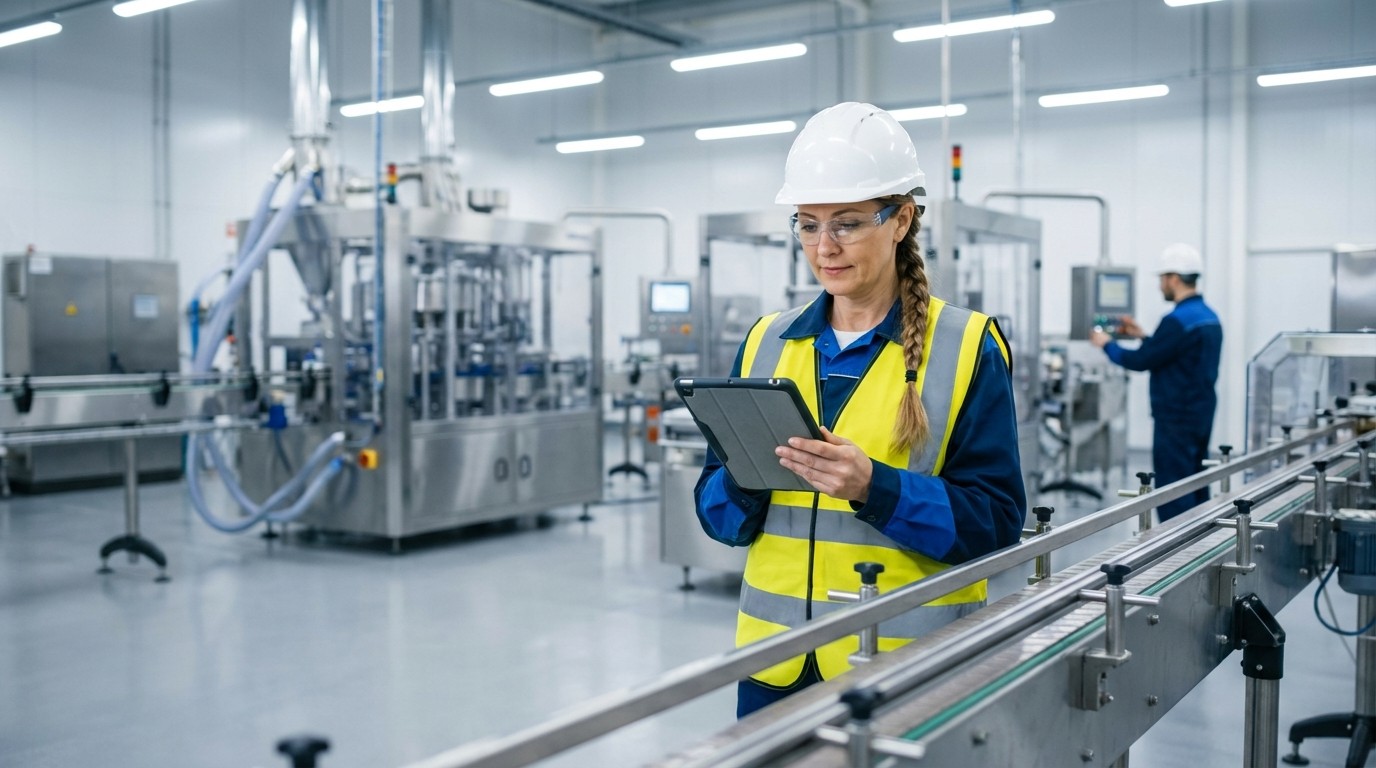
How to Improve OEE with Operator Input
Overall Equipment Effectiveness (OEE) remains one of the most powerful metrics for measuring manufacturing performance, yet many facilities struggle to achieve meaningful improvements. The secret to unlocking higher OEE scores doesn't lie solely in advanced automation or expensive machinery—it rests with the people who interact with equipment daily: your shop floor operators.
When operators transition from passive machine minders to active performance owners, the impact on OEE can be transformative. Manufacturers who successfully engage their frontline workers in OEE initiatives report scrap reductions of 25-50%, unplanned downtime reductions of 20-35%, and ROI measured in months rather than years.
The Human Data Gap: Why OEE Improvements Stall
Here's a scenario that plays out in facilities worldwide: It's 6:47 AM when Line 3 goes down. The production manager rushes to the control room. The dashboard tells a familiar story—pressure dropped, line stopped, temperature high. The system recorded what happened. It can't explain why.
A veteran operator walks past on his way to clock in. He pauses, cocks his head toward the silent machine: "That bearing. It's been sounding different for about a week. Higher pitch. I mentioned it at shift change, but..." He shrugs and walks on.
No sensor detected the changing sound. No dashboard flagged it. Only the operator's ears—trained over nearly three decades—heard the subtle change that presaged failure. The observation existed in his head, in a comment at shift change, perhaps in a margin note no one read. It never entered any system.
This is the Human Data Gap—the disconnect between what operators know and what systems capture. Machine data tells you what happened. Human data tells you why. In most organizations, these two sources of intelligence don't connect.
The Operator as Advanced Sensor
This scenario reveals a fundamental undervaluation. Manufacturers have invested billions in sensors detecting temperature, pressure, and vibration. They've invested virtually nothing in systematically capturing operator observations.
Operators perceive what machines miss: subtle changes in sound frequency and rhythm, off-gassing and overheating before thermal sensors trigger, vibration patterns and surface textures indicating wear, color variations and surface anomalies, and pattern recognition across multiple factors and timeframes.
The reframe that matters: operators are the most advanced sensors in the factory. The challenge isn't getting them to do more data entry—it's capturing what they already perceive, with zero friction.
Understanding the Two Bottlenecks
Operational excellence principles aren't complicated. Observe what's happening, identify gaps, isolate causes, test changes, measure results, standardize what works. An operator who tries changing one thing to see what happens is applying the same logic as a Six Sigma Black Belt.
So why has operational excellence remained the domain of specialists? Not because the principles are hard—because the infrastructure required specialized skills. Two bottlenecks have kept OEE improvements in the hands of the few:
The Contribution Bottleneck: Getting meaningful observations into systems has always required effort—forms, logins, dedicated time. If documentation takes 8 minutes, only significant issues get reported—inconsistently. Operators became subjects of improvement efforts, not agents of them.
The Intelligence Bottleneck: Getting insights from data has always required expertise—database queries, statistical tools, specialized software. Even when data existed, only a small group could interpret it. The shift supervisor who noticed something couldn't investigate whether it correlated with machine data without submitting a request and waiting days.
These bottlenecks reinforce each other. Because contribution is hard, data is thin. Because analysis requires specialists, contributors rarely see value from their input. The cycle perpetuates—and OEE stagnates.
Removing Both Bottlenecks: Democratized Contribution
Consider the bearing story again. In the old model, documenting that observation required walking to a terminal, logging in, navigating a form, describing the issue, categorizing it. Eight minutes minimum. The operator was in the middle of work. He made a mental note for shift change—and forgot.
In the new model: The operator pulls out his phone, taps one button, and says "Line 3 bearing sounds higher pitched than normal—started noticing it yesterday, getting more pronounced." He snaps a photo of the status display. Total time: 20 seconds.
His observation is automatically transcribed, timestamped, linked to the equipment record, and categorized. When the bearing fails days later, his observation is right there on the timeline, correlated with the vibration data that started trending upward.
This is what zero friction means. Not easier forms—friction eliminated entirely.
When documentation takes 20 seconds instead of 8 minutes, the threshold for "worth documenting" drops dramatically. The minor observation, the vague instinct, the "probably nothing but..."—all of it enters the system. Organizations implementing this approach see 5× increases in data captured.
Democratized Intelligence: Making Analysis Accessible
The reverse direction matters equally for OEE improvement. Operator observations—previously trapped in informal language and verbal handoffs—can now be queried and correlated with machine data by anyone.
A shift supervisor wants to understand why yesterday's batch took 20% longer. Previously: submit a request to engineering, wait days. Now: ask in plain language, "What was different about Batch 247 compared to the previous ten batches?"
Within seconds: "Batch 247 had three notable differences: reaction temperature ran 2°C higher during phase 2, raw material lot was from Supplier B, and there was a 15-minute hold during charging. The temperature deviation correlates with the extended cycle time."
No database expertise. No waiting for analysts. The supervisor can ask follow-ups, drill into specifics, and reach conclusions in minutes. Root cause analysis time drops by 60-75% when human and machine data become immediately available together.
The Unified Timeline: Connecting What and Why
The infrastructure connecting both sides is the unified factory data timeline—human observations and machine data on a single time axis, correlatable and analyzable together.
Every manufacturing organization has someone whose real job is translation: gathering data from different systems, holding it in their head, trying to find connections. The quality issue from Tuesday. The maintenance note from Monday. The operator comment about the material. Each piece in a different place, different format.
This person is invaluable—and they're a bottleneck.
The unified timeline distributes that capability. Observations are captured as they happen. Machine data flows continuously. Correlation happens automatically. When an issue needs investigation, the data is already assembled.
The Bearing Story on the Unified Timeline:
Time | Machine Data | Human Data |
|---|---|---|
Day -7 | Vibration: normal | Operator note: "Bearing sounds higher pitched" |
Day -5 | Vibration: +5% above baseline | — |
Day -3 | Vibration: +12% | Shift handoff: "Keep an ear on Line 3 bearing" |
Day -1 | Vibration: +18% | Correlation flagged automatically |
Day 0 | Scheduled maintenance | Bearing replaced before failure |
No failure. No €55K cost. Not because someone brilliantly connected the dots—because the dots connected themselves.
The Virtuous Cycle That Drives Sustained OEE Gains
When democratized contribution and democratized intelligence connect, they create a self-reinforcing cycle:
More people contribute → Data becomes richer → Analysis surfaces meaningful patterns → Patterns lead to visible improvements → Contributors see their input matters → More people contribute
This is how operational excellence becomes self-sustaining rather than project-dependent. Not heroic effort, but infrastructure that makes improvement the natural result of work.
The Psychology of Contribution: Making Operators Want to Share
Zero friction is necessary but not sufficient. Operators must choose to share.
The most corrosive belief is "nobody will do anything anyway." If operators have watched observations disappear without response, suggestions go unacknowledged, systems get implemented and abandoned—they've learned that contribution is pointless.
What makes people share:
Visible Value: Operators must see that their observations matter. Acknowledge contributions. Show connections. Act on what's shared. The first time an operator sees their observation lead to a solved problem, something shifts. They become believers.
Safety to Report: Operators must trust that observations won't be weaponized. If the culture punishes problem-surfacing, people stay quiet regardless of how easy capture becomes.
Lowered Threshold: Explicitly encourage "small" observations. "If you notice anything—even if you're not sure it matters—capture it." The system finds patterns in observations that individually seem insignificant.
Two Cycles Must Turn for OEE Improvement
There's a data cycle: more observations → richer analysis → visible value → more contribution.
There's an organizational cycle: stability → cognitive space → willingness to contribute → problems solved → more stability.
Both must operate. A perfect data cycle won't turn without organizational conditions—stability, safety, leadership attention. Perfect organizational conditions won't create value without a platform capturing and connecting data.
The technology enables the cycles. Leadership sustains them. When supervisors respond to every observation—especially early on—they prove that visible value is real. This is critical to getting the virtuous cycle spinning.
Closing the Loop: From Insight to Sustained Practice
OEE improvements only stick when insights become embedded practice. Based on investigation, the supervisor documents the fix. Next month when similar conditions appear again, operators automatically see the adjusted procedure. Knowledge compounds instead of disappearing.
This living documentation approach transforms how improvements sustain. When a plant identifies that certain material lots require adjusted parameters, that knowledge surfaces automatically the next time those materials run—not because someone remembered, but because the system connects the pattern to the procedure.
The Results When Both Sides Connect
Manufacturers implementing this two-sided democratization—removing both the contribution and intelligence bottlenecks—achieve measurable outcomes:
Metric | Result | Driver |
|---|---|---|
Scrap Reduction | 25-50% | Root causes identified through human context |
Unplanned Downtime | 20-35% reduction | Early warnings from operator observations |
Root Cause Analysis Time | 60-75% reduction | Human + machine data immediately available |
Data Captured | 5× increase | Friction reduced from minutes to seconds |
ROI Timeline | 2-4 months | High-value problems addressed first |
Conclusion: Your Operators Hold the Key to Higher OEE
Your operators hold the key to unlocking higher OEE. They possess knowledge, observations, and insights that no automated system can replicate. By providing tools that make data capture effortless, creating systems that transform input into action, and building a culture that values frontline expertise, manufacturers can achieve substantial and sustainable OEE improvements.
The shift from viewing operators as data sources to recognizing them as sensors and problem-solvers represents a fundamental change in how manufacturing operations are optimized. When you reduce the barrier to contribution to zero and make capturing critical insights as easy as conversation, you transform your most valuable resource—your people—into your greatest competitive advantage.
The virtuous cycle is waiting to turn. The question isn't whether your operators have insights that could improve OEE—they do. The question is whether you have the infrastructure to capture those insights, connect them to machine data, and make the patterns visible to everyone who can act on them.
This is what the Oppr.ai Digital Operator Platform enables: LOGS captures operator observations in 20 seconds through voice and image. IDA analyzes patterns across human and machine data using natural language queries. DOCS turns insights into living documentation that surfaces at the right time. Together, they create the infrastructure for democratized operational excellence—where everyone contributes, everyone accesses intelligence, and everyone drives improvement.
Ready to future-proof your Operations?
Discover how Oppr's integrated platform simplifies data capture, centralizes knowledge, and delivers the actionable intelligence you need to empower your team and drive real ROI.