Most plants we talk to are trying AI somewhere. Far fewer can say what it changed on the line.
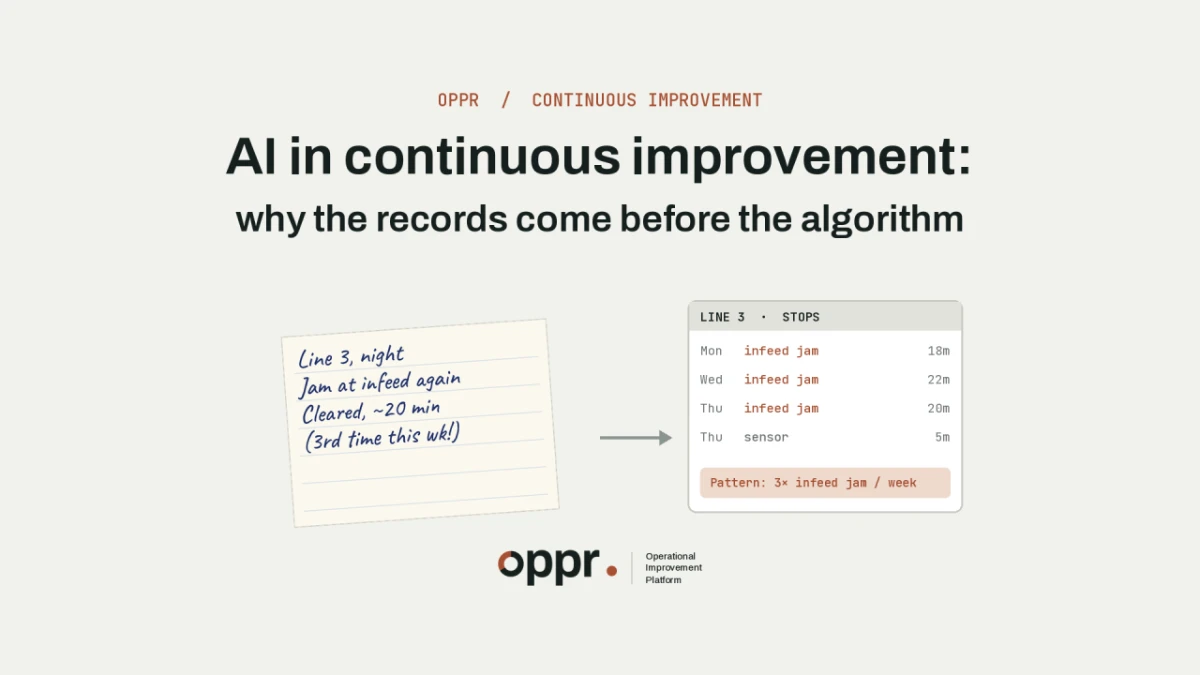
Picture a morning meeting in a process plant. The dashboard shows last night’s stops. The maintenance system has a work order for the same pump as last month. The shift lead says the pump was fine, the feed changed at three. That last sentence is the most useful piece of information in the room, and it is not in any system.
That is where AI in continuous improvement usually stalls. Not on the model. On the records.
The algorithm is rarely the constraint
This month a maintenance software vendor, Limble, published its State of Maintenance report, based on a survey of US maintenance and operations staff. Its conclusion is blunt: “Teams have to fix how maintenance work gets recorded before AI can do much with it.” The report adds that AI in maintenance “runs on the records a team already keeps, making the quality of those records the thing that decides how far it gets.” (Source: Facilities Dive, 9 Oct 2026)
The same report describes something every plant manager will recognise: teams that own a maintenance system but do not all use it regularly, and people asking a colleague for information the system already holds.
Xometry’s 2027 manufacturing outlook points the same way from another angle. Reported returns from AI are rising. But Xometry itself cautions that much of that return comes from general-purpose tools. Those tools are not grounded in real pricing, capacity or production data. (Source: Manufacturing Dive, 7 Oct 2026)
At the other end of the market, Schneider Electric plans to acquire PTC. Analysts frame it as a bet that industrial AI needs context across product, machine and process data. (Source: Futurum Group, 6 Oct 2026)
We agree that context is the constraint. We would add one thing. In most plants, the context that is missing is what the shift saw.
Two ways this goes wrong
We see two failures, and they are one failure from two sides.
- 01Improvement without digitization decays. A team finds a fix in a kaizen or a root cause session. The shift applies it. Holding it depends on a checklist or a round by hand. Work that nobody measures stops, and the fix fades.
- 02Digitization without a problem becomes a burden. Everything that could be captured is captured, in case it becomes useful. Nobody makes a decision from it. The shift spends time every day feeding a system that gives nothing back. Then AI is pointed at that data, and it turns up patterns nobody can act on.
Adding AI to either of these does not fix them. It speeds them up.
What continuous improvement already knows
In principle none of this is new. Lean, Six Sigma and every good OpEx programme start with a defined problem, go to the floor, test a hypothesis and standardise what holds. The difference AI can make is speed: doing the analysis on the fly instead of waiting weeks for a consultant to pull the data together.
But the order does not change. The problem first. Then the records the problem needs. Then the analysis.
Digitize what the problem needs, not what the system can capture.
How we work: Capture, Connect, Execute, Verify
This is how we put AI into continuous improvement at Oppr.
- Capture. The shift notes what it sees at the machine, on the phone it already carries: a photo, a few words, a voice note. Only where a recurring problem needs an observation.
- Connect. Those notes sit next to the machine data on one timeline. AI analysis looks across both and proposes hypotheses. People test them on the floor; the analysis does not decide.
- Execute. The plant’s own people test each hypothesis on the floor and make the call. What holds becomes standard work. A disproved hypothesis is a valid outcome too.
- Verify. What was captured goes back to the shop floor. Every shift confirms the action with a photo, a reading or a sign-off, so the gain holds and the next improvement starts higher.
Each cycle leaves a measured improvement and a plant that is a little more digital: one manual round replaced, one observation added only where it was needed.
There is a limit. This works best on a recurring problem someone on site can already name. It is not a way to digitize a plant from scratch.
Where to start
If you are weighing AI for your improvement work, a few questions help before any tool is chosen:
- Which recurring problem would you most like to stop solving twice?
- What does the shift know about it that no system records today?
- Who would test a hypothesis on the floor, and who would confirm every shift that the change still holds?
If those answers are clear, the algorithm is the easy part.
Which records in your plant would you trust enough to let an analysis argue with them?