
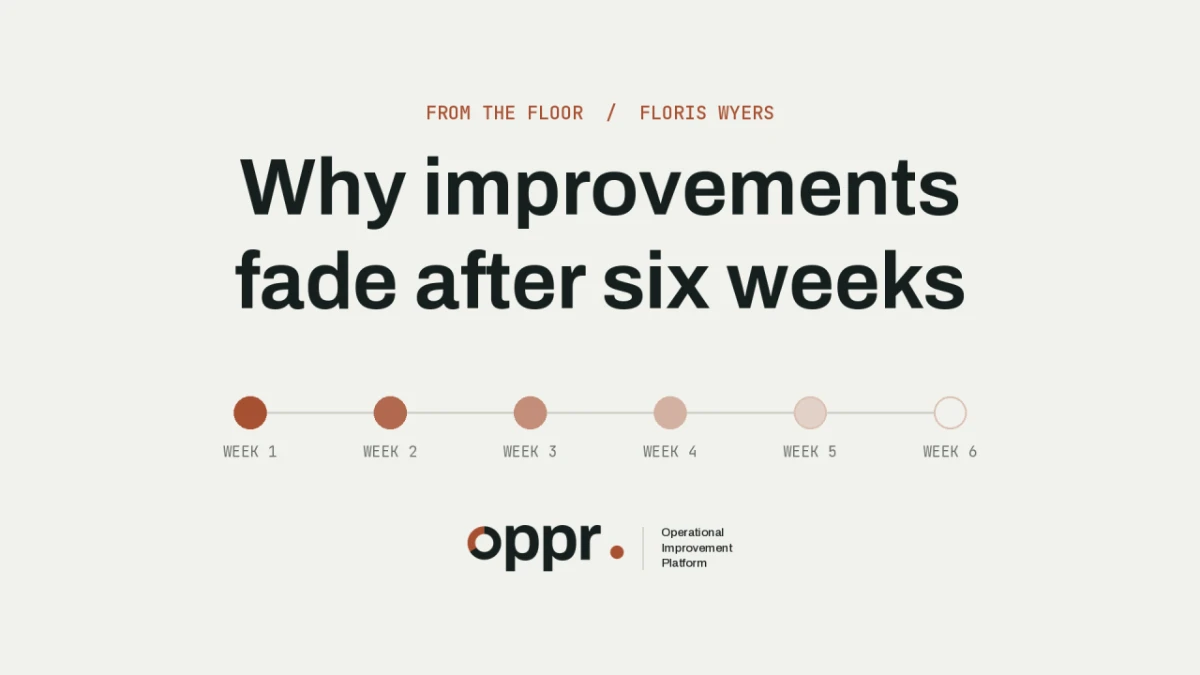
In my years running plants, the hard part was rarely finding an improvement. Good people on a line find them all the time. The hard part was still having that improvement two months later.
I still see it today, in the plants I work with now. A customer in fermentation told me about a bad batch that led to a new routine for feeding and for checking pH and temperature at set moments in the shift. They agreed it together, and for a while every shift did it the same way.
Then a feed moved a little when the line was busy. A check slid from the start of the shift to the end. New people learned the version they saw, not the one that was agreed. Nobody broke the routine. It drifted, one handover at a time, until the next batch went wrong and they were back in the same meeting.
The kaizen that lasted six weeks
Picture a line where the changeover always runs long. A team spends a week on it and finds three things that matter.
- 01A setting that drifts on start-up.
- 02A check that happens too late.
- 03A tool that is never where it should be.
They write it down, train every shift, and the next week the changeover is shorter.
Then the weeks pass. A night shift has a bad start and skips the check once, because the line is waiting. Nothing goes wrong. The tool board gets one empty hook, then two. Nobody decides to drop the improvement. It just stops being done.
Six weeks is a picture, not a measurement. Sometimes it is three weeks, sometimes three months. The shape is what matters: a clear gain, then a slow slide that nobody sees until the number comes back.
Why holding the gain is harder than finding it
Holding the gain needs someone to keep doing something. Keep a spreadsheet. Walk a round. Tick a box at the start of the shift. Sign the standard work sheet. The improvement has turned into work.
And work that nobody measures stops.
Not because people are lazy. A shift lead has a full handover, a late truck, a pump that sounds wrong, a sample out of spec. Each of those has someone asking about it today. The checklist from the kaizen week has nobody asking. So it slides to the bottom of the list, and then off it.
I saw the same thing at a tire pyrolysis plant. The start-up procedure for the reactor lived in a binder in the control room. It was correct, signed off, and almost nobody opened it. The real start-up lived in the heads of a few experienced operators: when to wait a little longer, which reading to trust, which sound meant trouble. When one of them was on shift, start-up went smoothly. When none of them was, it went slower and rougher. The binder was the standard on paper. The operators were the standard in practice.
Standard work only holds if someone can see it
In principle none of this is new. Lean has a word for it: sustain, the last S in 5S. PDCA has a check step for a reason.
What I found hard was not knowing that. It was seeing, shift by shift, whether the new standard was still being followed, without walking the floor with a clipboard myself.
The information that tells you whether an improvement still holds is on paper, on a whiteboard, or in someone’s memory of last night. You can’t see it from the office. You find out when the number goes back up, weeks later, and by then nobody remembers which part slipped first.
What changes when the shift confirms it
A gain only holds when the people on the shift stay involved and it becomes part of the way they work.
The best example I have is from a plastic recycling plant. We changed how one step in the process was checked, and unlike most changes, it stayed. Three things were different. It had one clear owner, who felt it was theirs. Each shift confirmed it with something small at the handover: a photo or a reading, nothing more. And the shift lead looked at those confirmations and went back to the floor with feedback. A word of thanks when it was done. A question when it was skipped, and sometimes a better way that came out of that question.
That last part matters most. If an operator confirms a check every shift and never hears about it, the confirmations stop too.
It also changes how you look at the difference between shifts. Same machine, same recipe, two shifts, two results. The gap between shifts is process evidence hiding as variation, not a people problem. It is never about scoring an operator. It is about finding out which way of working holds, so it can become the standard for everyone.
When the confirmation is digital and simple, the improvement leaves something behind. Not a binder, but a record of what was done, on which shift, next to what the machine did at the same time. Each improvement is held in place, so the next one starts higher.
It has limits. It won’t turn a bad standard into a good one, and it doesn’t replace the shift lead who walks the line and asks.
The question I keep asking
Put one improvement in place. Hold it. Build the next. That line is the reason I started Oppr.
So here is the question I would ask about any line.
Which improvement from last year is still being done on the night shift, and how would you know?