Open the fault log of last month. Find the stop reason that comes up most. In many plants it is one word: “Other”.
Or “Unknown”. Or “Waiting”. A code that nobody can act on, at the top of the list that should tell you where to act.
The biggest stop reason has no name
A fault log is made to answer one question: where does the line lose its time? When the largest part of the answer is “Other”, the log does not answer it.
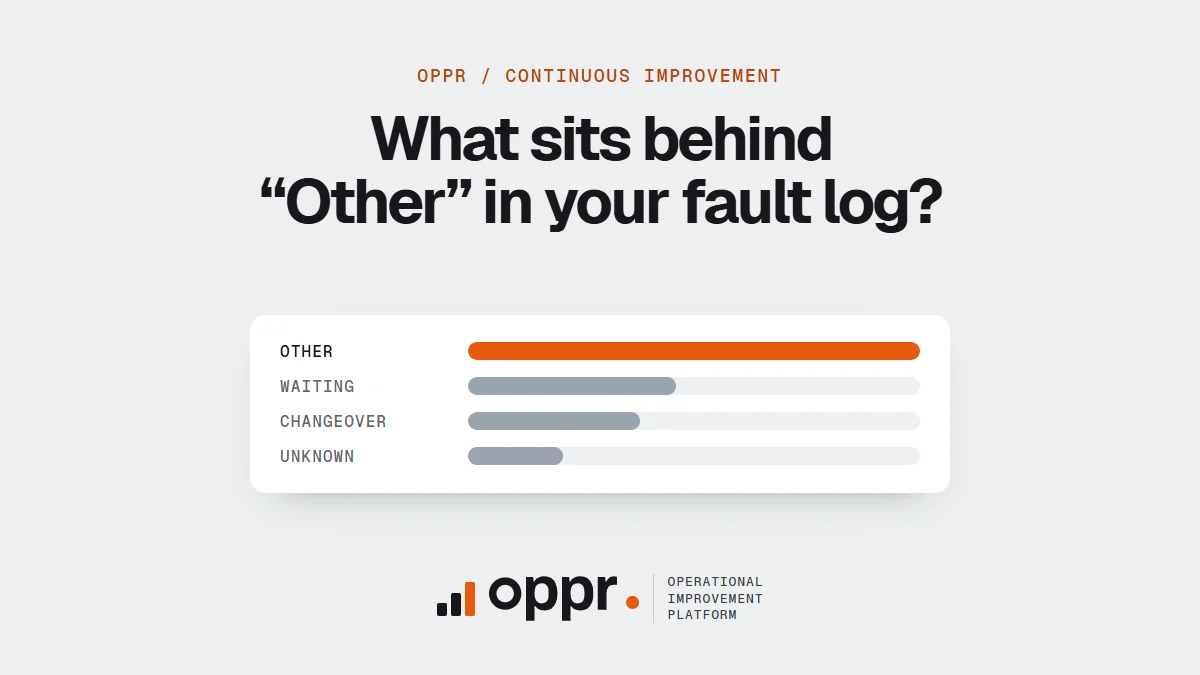
- Other
- Waiting for material
- Changeover
- Filter blocked
- Unknown
The longest bar is the one nobody can act on.
- The belt jammed at the transfer.
- The sensor eye was dirty again.
- The valve hissed after the changeover.
Behind that one bar there is a list. The belt that jammed at the transfer. The sensor eye that was dirty again. The valve that hissed after the changeover. The crew knows that list. It is just written nowhere.
Why crews pick “Other”
This is not careless work. The system sees that the line stops. It does not see why.
Someone must then pick a code, after a three-minute stop, with the line running again and the next task waiting. The list of codes is long, and the real cause is often not on it. So the operator picks the fastest code.
“Other” is not a reason. It is the cost of reporting, paid in the fastest way.
Operators know weeks ahead
Operators often know long before a failure that something is wrong. They hear it in a bearing. They see it in the way a pipe leaves the bath. They feel it in a valve.
But the signal is too small. What do you report? “It sounds different”? Nobody raises a work order for that. So they tell a colleague at the handover, maybe. After you say something three times, you do not say it a fourth time.
Two weeks later the line stops. Afterwards, everyone knew.
We do not think this is about people. It is about the threshold. The effort to report is bigger than the signal.
Make reporting as small as the signal
The fix is not a longer list of codes. It is a smaller step to report.
- 01At the machine. The operator speaks a voice note or takes a photo on the phone they already carry. It takes about 20 seconds.
- 02In their own words. No code to pick. “The belt jammed again at the transfer” is enough.
- 03At the right moment. Each note lands on one timeline, next to the machine data of that minute.
A note that takes 20 seconds gets made. A form that takes five minutes does not, and certainly not during a night shift with a stop to fix.
What “Other” turns into
When the crew can say each stop once, in its own words, “Other” stops being one bar. It becomes a list of named stops, each at its moment, next to what the machine did.
Then practical AI can connect the notes with the machine data and uncover the root cause. Your engineers confirm it on the floor. The fix becomes standard work for every shift. That is the order we work in: Identify, Analyze, Realize. You can read how it works for one filter in From 35 minutes to 2: one filter, three steps.
Start small. Take the largest code that nobody can act on, and ask the crew to say each of those stops once, for a few weeks.
What would sit behind “Other” in your plant, if the crew could say each stop once?